Ethiopian Opals: Earth’s Living Light
Do Ethiopian Opals are the gemstones that sparkle the most? And is that why people say they are gemstones that move? Ethiopian opals don’t just reflect light they seem to hold it, bend it, and release it in flashes of fire that shift with every angle. No two are ever the same. Each one feels like a tiny universe sealed inside stone. From the volcanic highlands of Ethiopia, these opals have captured the attention of collectors, jewelers, and dreamers around the world. But what makes them so special goes far beyond color.
David Jones
5/8/20242 min read
Ethiopian Opals: Earth’s Living Light
There are gemstones that sparkle.
And then there are gemstones that move.
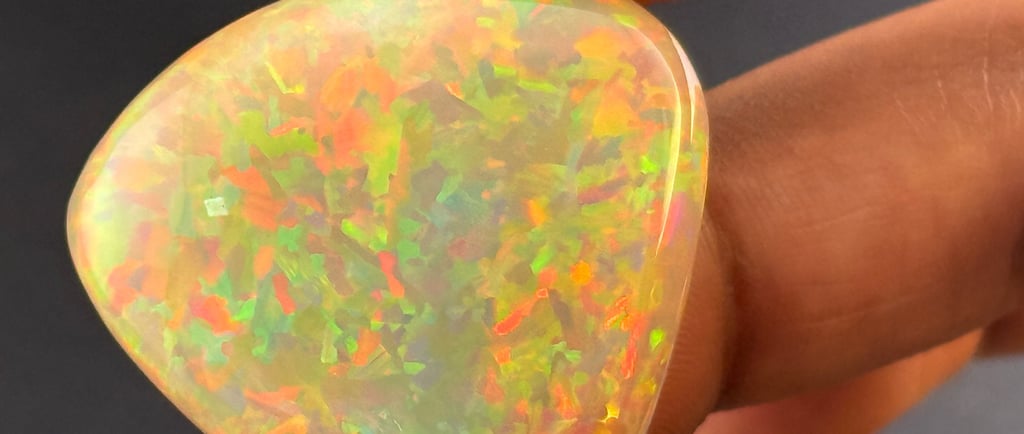
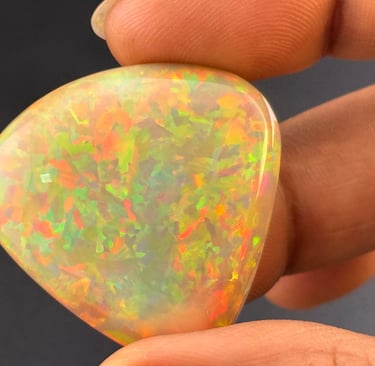
Ethiopian opals don’t just reflect light they seem to hold it, bend it, and release it in flashes of fire that shift with every angle. No two are ever the same. Each one feels like a tiny universe sealed inside stone.
From the volcanic highlands of Ethiopia, these opals have captured the attention of collectors, jewelers, and dreamers around the world. But what makes them so special goes far beyond color.
Born From Fire and Water
Unlike many gemstones formed deep underground under immense pressure, Ethiopian opals are born in a more unusual way.
Millions of years ago, volcanic eruptions created layers of ash and rock. Rainwater slowly seeped through this material, dissolving silica. Over time, that silica-rich water filled tiny cracks and cavities. As the water evaporated, microscopic silica spheres were left behind stacked in orderly patterns.
It’s this microscopic structure that creates opal’s famous “play-of-color.” When light hits the stone, it diffracts through those spheres like a natural prism, producing flashes of red, green, blue, and gold.
In Ethiopian opals, this process often results in:
Bright, wide flashes of color
Transparent to crystal-like body tones
Unique internal patterns that seem to float
Why Ethiopian Opals Feel Alive
Many people describe Ethiopian opals as “living stones.” While that may sound poetic, there’s a scientific reason behind the feeling.
Ethiopian opals are often hydrophane meaning they can absorb water. This can temporarily change how they look, sometimes making them more transparent or altering their color play until they dry again.
This quality makes them:
More dynamic
More sensitive
More individual
They respond to their environment in subtle ways, which adds to their personality. It’s as if the stone breathes with its surroundings.
A Random but Fascinating Connection: Opals and Lightning
Here’s something unexpected.
Scientists believe opals and lightning share something in common: sudden energy and rapid change.
Some Ethiopian opals form in volcanic regions where intense electrical storms and geothermal activity occur. Rapid environmental shifts heat, water movement, mineral flow can influence how silica deposits form.
In a way, opals are geological “snapshots” of moments when the earth’s energy was especially active. Just like lightning freezes a burst of energy across the sky, opal freezes movement inside stone.
That’s why many opals look like:
Frozen flames
Storm clouds lit from within
Galaxies in motion
They capture motion inside stillness.
No Two Stones, Ever
With diamonds, two stones can be almost identical. With opals, this is nearly impossible.
Each Ethiopian opal has:
A different pattern of color
A unique internal structure
Its own balance of transparency and fire
This means owning an opal is not like owning a product it’s like owning a natural artwork that can never be repeated.
Beauty With Meaning
Ethiopian opals are also connected to the people and land where they are found. Many stones pass through the hands of local miners and artisans before reaching the world. Each gem carries not just geological history, but human story.
Choosing an Ethiopian opal is choosing something:
Natural
Individual
Full of movement and life
The Magic of Light in Stone
At its heart, an opal is a reminder that light can be trapped, shaped, and revealed in unexpected ways.
It teaches us something simple:
Even inside solid stone, there can be motion, color, and life waiting to be seen.
And that may be the true uniqueness of Ethiopian opals
they show us that beauty is not fixed. It shifts, changes, and reveals itself slowly, just like the earth that created them.