Ethiopian Opals vs Other Opals: What Makes Them Different?
Why do Ethiopian opals look alive? This article explores how geology, light, and nature’s structure create the glowing, shifting beauty that makes these opals unlike any other gemstone. Learn the key differences between Ethiopian, Australian, and Mexican opals. Understand hydrophone properties, volcanic formation, and why Ethiopian opals display such vibrant internal light.
Larry David
5/8/20242 min read
Ethiopian Opals vs Other Opals: What Makes Them Different?
Opals are found in several places around the world, but not all opals are the same. If you’ve ever seen an Ethiopian opal next to an Australian or Mexican opal, you might notice something immediately:
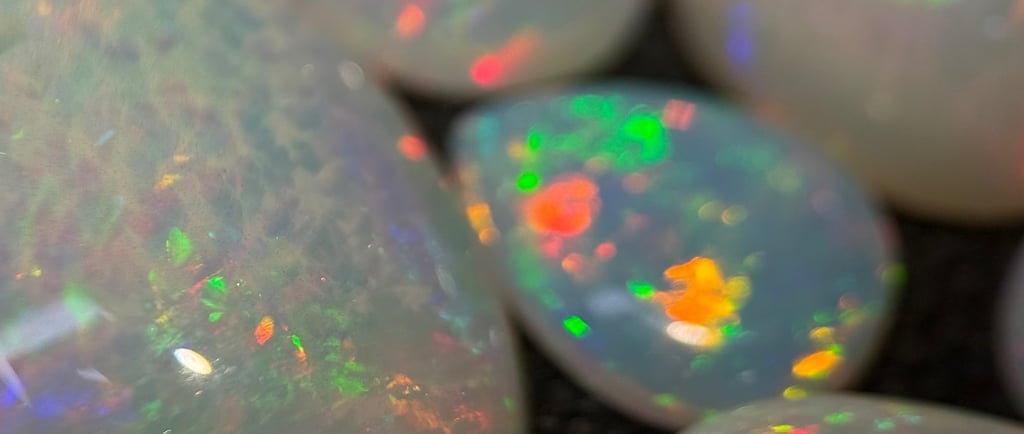
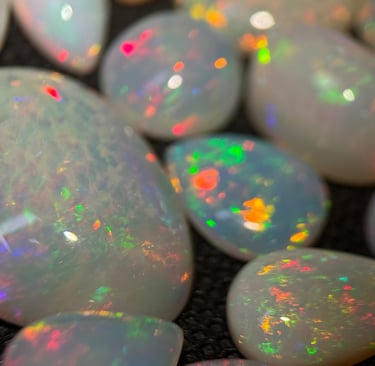
Ethiopian opals seem… alive.
The difference isn’t just visual it comes from how and where they are formed.
A Quick Look at Opal Types
Here are the main sources people compare:
OriginTypical LookBody ToneStructureEthiopiaBright, wide color playCrystal, white, honeyOften hydrophaneAustraliaDeep, stable colorsDark, black, boulderNon-hydrophaneMexicoWarm glow, less play-of-colorOrange “fire opal”Often transparent
Each is beautiful but Ethiopian opals stand apart in personality and movement.
The Transparency Effect
Many Ethiopian opals are crystal or semi-transparent. Light travels through them, not just across the surface.
This creates:
Depth instead of flat color
Floating flashes that appear suspended inside the stone
A glowing effect rather than just sparkle
In comparison, darker Australian opals show contrast and drama, but Ethiopian opals show light from within.
The Hydrophane Character
One of the most unique features of Ethiopian opals is that many are hydrophane they can absorb water.
This doesn’t make them fragile; it makes them responsive.
It means:
They can temporarily change appearance
They have a softer, more organic nature
Each stone reacts a little differently
No other major opal source is known for this characteristic to the same degree.
Formed in Volcanic Landscapes
Ethiopian opals come from volcanic highlands. The geology is different from Australia’s sedimentary deposits.
This volcanic origin leads to:
Large, clean crystal opals
Wide flashes of color
Unique internal patterning
It’s as if the stone carries the memory of fire and water at the same time.
A Fun Connection: Opals and Galaxies
Here’s a surprising parallel.
Scientists use the same concept ordered structures scattering light to explain both opal color and certain cosmic phenomena.
The microscopic silica spheres inside opal are arranged in patterns that break white light into spectral colors. In space, dust and gas clouds scatter starlight in a similar way, producing nebula-like color effects.
That’s why some Ethiopian opals resemble:
Distant galaxies
Nebula clouds
Cosmic storms
You are literally holding something that mirrors processes seen in the universe.
Why Collectors Love Ethiopian Opals
Collectors are drawn to them because:
Each stone is unique
The color play is bold and expressive
They feel natural and organic
They have personality, not uniformity
Owning one is less like buying jewelry and more like owning a piece of earth’s creative process.
The Human Connection
Ethiopian opals also represent a direct link to the communities where they are mined. Many stones are cut and traded through networks of local miners and artisans, adding human history to geological wonder.
The Takeaway
Australian opals are dramatic.
Mexican opals are warm and glowing.
Ethiopian opals are luminous and alive.
They are the stones of movement, depth, and light a meeting point between earth, water, and fire.
And once you see one in motion, you never look at gemstones the same way again.